Key Takeaways
- A CDD assessment has two parts: a debt-service (bond) portion that can often be paid off, and an operations & maintenance (O&M) portion that stays with the property.
- CDD debt rides on the annual property tax bill under Florida's uniform method, so it holds tax-lien priority and will not appear on a standard title search.
- Unpaid CDD assessments can trigger a tax certificate sale — the same enforcement path as delinquent property taxes.
- Get an estoppel or payoff letter from the district manager in writing before you clear to close; never rely on the tax bill alone.
- Florida Statute §190.048 requires a boldfaced CDD disclosure in the initial sale contract — but resale buyers are frequently caught off guard.
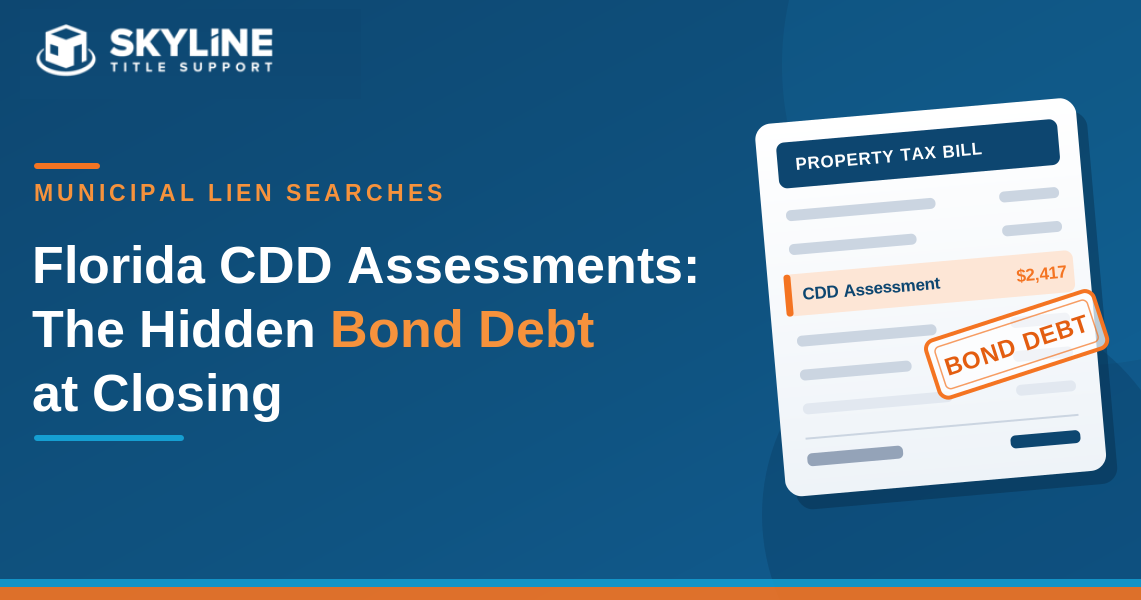
The title search is clean. The commitment is issued. Then the buyer's lender pulls the tax history and asks a simple question: "What is this $2,400 line on the tax bill, and does it get paid off at closing?"
That line is a Community Development District (CDD) assessment, and it hides one of the most misunderstood liabilities in Florida real estate: a bond debt that can run tens of thousands of dollars, does not show on a standard title search, and enforces exactly like unpaid property taxes. Here is what title and settlement professionals need to verify before that deal reaches the closing table.
What Is a CDD Assessment?
A Community Development District is a special-purpose local government created under Chapter 190 of the Florida Statutes. Developers use CDDs to finance the roads, water and sewer lines, drainage, and amenities in a new community by issuing tax-exempt bonds — then repaying those bonds through assessments levied on every parcel inside the district.
For a title professional, the critical point is that a single CDD line on the tax bill is really two different obligations:
Sample Annual CDD Assessment
Debt service (payoff-eligible)
O&M (ongoing, stays with property)
The debt-service (bond) portion
This is each parcel's proportional share of the district's capital bonds, typically amortized over roughly 20 to 30 years. It is a fixed payoff amount that can usually be prepaid in full — which is exactly why it matters at closing.
The O&M portion
This funds ongoing district operations — landscaping, amenity upkeep, management. It is reset by the district's board each year, it does not get "paid off," and it simply continues with ownership like any recurring charge.
National Note
Florida uses CDDs, but the pattern repeats nationwide: Texas has Municipal Utility Districts (MUDs), Colorado has metropolitan districts, and other states use special assessment or improvement districts. If you close in those markets, the same "bond debt on the tax roll" analysis applies.
Why CDD Debt Doesn't Show on a Standard Title Search
Here is the trap. CDD assessments are almost always collected using the uniform method under Chapter 197 — meaning they are billed and enforced right alongside ad valorem property taxes on the annual tax bill. Under that method the assessment carries the same priority as a property tax lien: it is superior to the mortgage and does not depend on a separately recorded instrument in the chain of title.
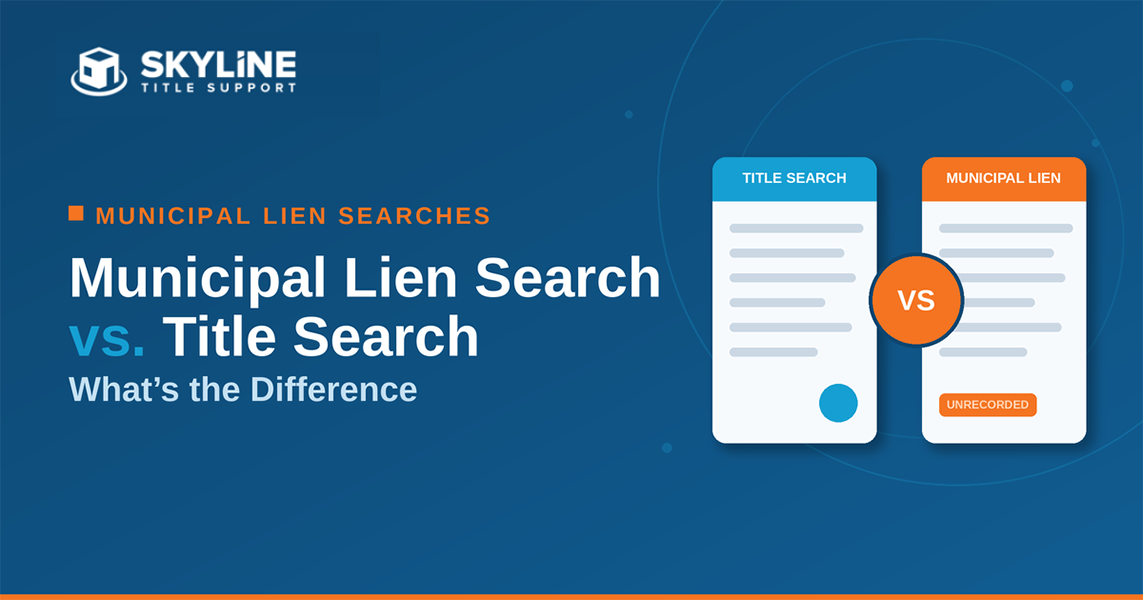
Because the obligation lives on the tax roll rather than as a conventional recorded lien, a routine title search will not surface the outstanding bond balance. The tax bill shows this year's charge — not the remaining principal a buyer is inheriting. That is precisely the gap a municipal lien search is designed to close.
Compliance Risk
Never treat the current-year CDD amount as the full liability. A $2,400 annual line can sit on top of a remaining bond balance of $15,000–$40,000+. If the contract is silent on who pays it off, you have an unallocated obligation heading into settlement.
A clean title search tells you nothing about the bond debt riding on the tax bill. Only the district can.
CDD vs. HOA: Don't Confuse the Two
Buyers — and sometimes closers — lump CDDs in with homeowner association dues. They are legally and mechanically different, and that difference drives how you clear each one.
| Feature | CDD | HOA |
|---|
| Created under | Fla. Stat. Ch. 190 (government special district) | Recorded declaration (private association) |
| How it's collected | Annual property tax bill (uniform method) | Direct bill / estoppel |
| Lien priority | Co-equal with ad valorem taxes (super-priority) | Junior; set by the declaration |
| Enforced by | Tax certificate & tax deed sale | Association lien and foreclosure |
| Payoff at closing | Bond debt portion can often be prepaid | Dues are ongoing; estoppel governs |
Because the two are cleared through entirely different channels, a property in a master-planned community may need both a CDD payoff figure and an HOA/condo estoppel. Missing either one leaves money on the settlement statement unaccounted for.
How Title Pros Clear a CDD at Closing
Clearing a CDD at Closing
- Confirm the district. Verify the parcel actually sits inside a CDD and identify the district by name — the tax bill and a municipal lien search will show it.
- Request the estoppel & payoff in writing. Ask the district manager or district counsel for a written estoppel showing the remaining bond balance, any prepayment premium, and delinquencies.
- Separate debt from O&M. Isolate the payoff-eligible bond portion from the recurring O&M so you know exactly what can — and cannot — be paid off.
- Prorate and allocate. Follow the contract on who pays the bond debt, prorate the annual assessment, and reflect it correctly on the settlement statement.
- Check delinquencies & disclosure. Confirm no prior-year assessments have gone to a tax certificate, and that the required §190.048 disclosure is in the file.
Pro Tip
Payoff figures expire. District estoppels are typically good only through a stated date, and prepayment amounts change when the next assessment roll is certified. Order the payoff close to your closing date and confirm it is still valid on the day of funding.
What Happens If CDD Assessments Go Unpaid
Because CDD assessments are collected on the tax bill, delinquency follows the tax-collection process — not a private lawsuit. Unpaid amounts can be sold as a tax certificate, and if left unredeemed, that certificate can ultimately lead to a tax deed sale. In other words, a missed CDD line carries the same teeth as unpaid property taxes.
For a closing, that means a delinquent CDD assessment can already be sitting behind a sold tax certificate that a title search never flagged. Verifying the certificate status alongside the payoff protects both the buyer and the underwriter from a post-closing surprise.
Frequently Asked Questions
Does a CDD assessment show up on a title search?
Not the outstanding balance. Because CDD assessments are collected on the annual property tax bill under Florida's uniform method, a standard title search shows the current tax status but not the remaining bond debt. A municipal lien search and a district estoppel are what reveal the full liability.
Can a CDD bond debt be paid off at closing?
Usually yes for the debt-service portion. Most districts allow the remaining bond principal to be prepaid in a lump sum, which removes that charge from future tax bills. The O&M portion is ongoing and cannot be paid off. Always request a written payoff figure from the district manager.
Is a CDD the same as an HOA?
No. A CDD is a governmental special district created under Chapter 190 and collected through the tax bill with tax-lien priority. An HOA is a private association billed directly and governed by its recorded declaration. A property can be subject to both, and each is cleared through a different process.
What is the §190.048 disclosure?
Florida Statute 190.048 requires a boldfaced, conspicuous disclosure in the contract for the initial sale of a parcel or unit inside a CDD, stating that the district may levy taxes or assessments. It is required for initial sales; resale buyers often are not warned as clearly, which is where confusion at closing starts.
Clear CDD Deals With Confidence
CDD assessments are not a reason to fear a closing — they are a reason to verify. The districts, the bond balances, and the payoff rules are all knowable, as long as someone actually checks the tax roll and requests the district estoppel before funding.
Skyline Title Support handles that legwork for title agents, real estate attorneys, and lenders nationwide — pairing municipal lien searches and tax certificate verification so no bond debt slips through. Request a quote and close your next CDD deal without the last-minute scramble.